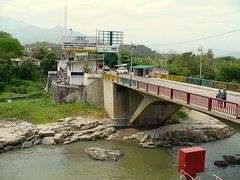
Lima Centro – Colonial Lima
The centre of the colonial city of Lima is the Plaza de Armas, and is the site at which Francisco Pizarro (conquistador who eradicated the Inca Empire) founded the city in 1535. The original plaza, and most of Lima, was levelled in 1746. The fountain in the centre, however, is one of the few things that date back to before the earthquake.
We visited the Plaza of San Martin (South American liberator from the Spanish) in the centre of which you can see his statue. To José de San Martin’s back-right is a street called Jirón de la Unión, which is pedestrianised. This street is bustling with people and is full of shops and shoppers. Following this street you eventually arrive in the Plaza de Armas. You can see from the photos attached to this entry the fountain in the centre and that it is surrounded on two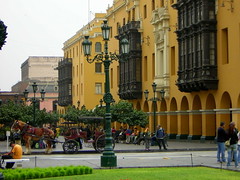 sides by large yellow colonial style buildings and to the north, with the Rimac river and train station behind, the Palacio del Gobierno (or Presidential Palace). If you plan to visit the centre of Lima, be sure to arrive in the square at 12pm sharp, where in the forecourt of the Palacio you will see the changing of the guard. The building on the fouth side of the square is La Catedral which was the first building to be reconstructed after the earthquake making it the oldest on the square.
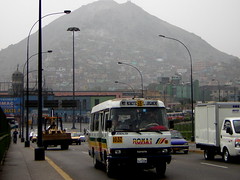 Behind the Palacio del Gobierno a new park has been built from which you can see the dirty trickle that is the Rio Rimac, it also has some archaeological remains of some extremely old Spanish defences for their new city. On the other side of Rio Rimac is the district of Rimac, into which suburban Annett refused to cross. You can see the poorly constructed houses and rickety buildings that are in the desert hills to the north of the city.
Before you arrive there though, there is a grand yellow pigeon-covered cathedral, now museum, called the Convento y Museo San Francisco. The interior walls are covered with ceramic tiles brought from Sevilla in Spain. Beneath the building there are vast catacombs where tens of thousands of the original inhabitants of the new city were buried and where hundreds of bones still lay.
After a meal in Barrio China, Lima’s China Town of 200,000 original Chinese railway-building immigrants, we stopped by the Congress building, next to which is the Museo de la Inquisition, where the tribunals for the Spanish Inquisition took place. The museum displays the torture chambers, instruments and jail cells.

Tags: cathedral, catholics, colonial, congress, inquisition, lima, plaza, rimac, san martin, spaniards