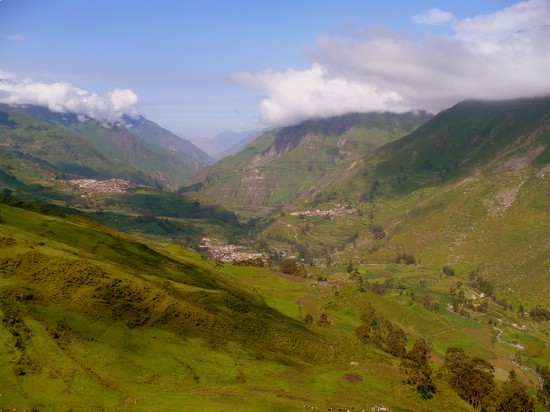
Huaraz is a city off the beaten path for many tourists to Peru, but has become an increasingly popular destination for adventure seekers and lovers of the great outdoors. The city itself is not the main draw. By far the main attraction to this area is the twin mountain range, the Cordillera Blanca and Cordillera Negra, a colossal corridor of rock which dominates the city and offers a tantalising escape into the Peruvian wilderness.
Category: "Ancash & Huaraz Guide"

Me vs. The Pastoruri Glacier
For The Karikuy Blog, Lani Conway details her struggle to reach the roof of the world.

An Andean Tradition: Knitting with Alpaca
Kate Robertson shares her experiences in the Andean region of Ancash and the story of an Alpaca knitting project she helped get off the ground.

Touching the Void
The story of Joe Simpson and Simon Yates was turned into a book and a film both entitled Touching the Void. Although previously attempted, Yates and Simpson were the first people to ascend to the summit of Siula Grande in the Cordillera Huayhuash via the almost vertical west face. Disaster struck, however, on the descent…

Cordillera de Huayhuash
As part of my series Explorando Lima, in which I try to demonstrate the vast diversity and astounding beauty of Peru – so much of it that you need not even leave the region of Lima to find it, I show you arguably the most spectacular and beautiful places on the face of the earth. A remote range of mountains visited only by the most experienced of high-altitude hikers. The Cordillera of Huayhuash.

Goodbye Huascaran
Today the World Heritage Body rejected a motion calling for cuts in carbon emissions after heavy lobbying from the Bush administration.
There are 125 Unesco World Heritage sites that are under threat from global warming, some of which are in Peru, including the area I visited a couple of weeks ago – Huascaran National Park.

The Chavín culture
A full two-thousand years before the rise of the Inca empire another culture ruled most of the central Andes and spread their influence yet further. The Chavín, from their capital Chavín de Huántar in modern day Ancash, and with their roots in the very first civilisations and city-states in the Americas such as Caral, Sechín and Ventarrón, created what was Peru’s very first empire. In doing so, they instilled an idea in Andean peoples that lasted until the arrival of the Spanish – rule under one government in one society with one common culture is beneficial in this harshest of environments, that better and central organisation would bring better crop yeilds, as well as more free time for monument building, religion and science.

Pastoruri
We left at 5am to climb Pastoruri (one of the more tiny peaks at a mere 5,240m / 17,187ft). We had to leave so early as there were protests in the town against something or other and all the roads would be blocked off. Such protests are commonplace in the Andes.
On the journey we stopped at the valley of Pachacoto to see the Puya Raimondi plants. These plants are bizarre looking and thought to be the oldest plant species on the planet. It lives for 100 years and flowers once, dieing immediately afterwards. Nearby were some old rock paintings.
The first few photos show the valley, the Puyas Raymondii and the rock paintings.

Huaraz
Huaraz is the largest city in the valley, the most industrial and most wealthy. From the hills that surround the city you can see that if fills this part of the valley completely. Being the largest city in Ancash though doesn’t make it modern. It is still relatively poor and many traditional adobe whitewashed houses and unpaved streets.

Caraz
We arrived in Caraz in the late afternoon, it caters for mountaineers but hasn’t got a lot else going for it. The town was hastily constructed after the devastating earthquake so isn’t the most pretty or traditional.
The photos show how lots of poor small towns look in rural Peru.

Lagunas de Llanganuco
On the road from Yungay to Caraz there is an access road to the lagoons under Huascaran.
Chinancocha is a laguna that stands at an altitude of 3850m and holds 1144300m3 of water.

Yungay
Could you imagine the ground trembling beneath your feet with such tremendous force that you could barely stand? Then have it stop abruptly with just enough time to get outside to apparent safety before a deep rumbling again shook the ground and darkness enveloped you? Nor could the little town of Yungay and its 25,000 inhabitants imagine they would be victims of Peru’s worst ever natural disaster.