» Some Nazca Lines aircraft over 50 years old
The amazing shapes and lines drawn on the plains of Nasca have led to a growth in passenger numbers at the Maria Reiche aerodrome of some 110% in the past 10 years. This however has not gone hand in hand with proper renovation of the terminal’s aircraft.
A recent finding by the El Comercio newspaper has shown that 90% of the 38 planes operating at the aerodrome are between 35 and 40 years old. One aircraft, with registration OB-1202, is a staggering 52 years old! Thankfully the operator, Nasca Air Lines, formally Aero Ica, has recently been shut down.
In a similar situation is the company Nasca Connection, who operate three light aircraft manufactured in the 60’s and two in 1976. They have however bought three new planes of the Caravan brand made in 1998, 1999 and 2004 - this meaning that on average they have Nazca’s most modern fleet.
Carlos Palacín Fernández EIRL, another of the operators that recently changed its name to Travel Air, offers its services with six light aircraft built between 1961 and 1980, while Aero Paracas owns five aircraft built between 1960 and 1963. These are joined by Alas Peruanas who operate four planes with ages between 28 and 45 years, Expreso Moche has one plane from 1983, Aero Santos with one from 1966, Alas de América with one from 1973, Taxi Aereo Ejecutivo with two from 1963 and 1972, and finally Aero Palcazú with planes between 26 and 32 years old.
Without Peru’s Ministry of Transport (MTC) and Directorate General of Civil Aviation (DGCA) pushing for and legislating for renovation, little if anything is likely to be done.
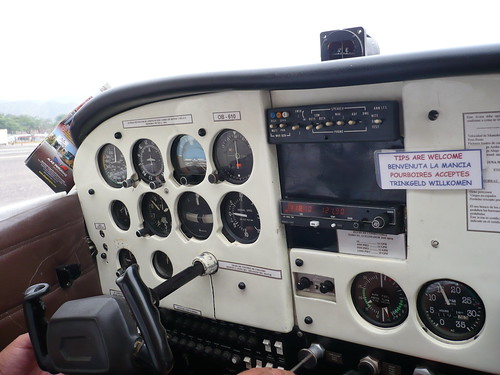
A source at the aerodrome explains that on these old planes, navigation is carried out visually and by radio, whereas in other countries it is done by satellite. “In other countries this assistance from air traffic is through satellite equipment to minimize risks”.
The source goes on the explain that the 38 light aircraft that operate from the aerodrome have the exact same control panels, instruments, equipment, cabs, seats, doors, fuselage and wings from the year they were built. Nothing has been renewed.
Another issue is the limited passenger capacity. Of the 38 aircraft, 17 have space for three passengers, 12 for six passengers and only 4 for twelve passengers. This means, due to saturated skies over the lines, their is little capacity for further grown in tourism.
Accidents
In March of this year, five French citizens were killed after mechanical failures caused their plane to crash. The aeroplane was operated by Aeroica (Aero Ica) which has now had its operations shut down.
Last December a light aircraft belonging to Aerocondor carrying four French tourists had to make an emergency landing on the Panamerican highway due to a mechanical fault. Just days before, also due to a mechanical fault in their ageing fleet, 12 Japanese tourists and one North American were also involved in an emergency landing. The company’s licence to operate was revoked.
In March of 2007, another five French tourists almost lost their lives when their plane ran out of fuel mid-air. The operating company Aero-Palcazú had not given the group enough fuel to complete the trip. Luckily the pilot was able to land on the Panamerican highway without hitting cars.
Ten years ago, one of the worst accidents occurred. Two aircraft hit each other over Nazca killing ten Italian and German tourists.
Related Posts:
- The Nazca Lines
- Maria Reiche
- The Nazca Civilisation
- Car Accident
- Could the Nazcans fly?
- Nine fingered destiny of Maria Reiche


December 3rd, 2008 at 9:12 am
Older aircraft do NOT mean unsafe aircraft. Appropriate, regular preventative and corrective maintenance is the key. Most small aircraft are older, and they remain a safe form of transportation as long as appropriately cared for.
If you want to worry about airplanes, consider the new plastic (fiberglass, carbon-fiber) designs and the effects of ultra-violet sunlight on the materials.
Meanwhile, simply ensure that whoever you fly with has proper training, and ask about their maintenance practices.
As to navigation, satellites or ground stations - if you can see where you are going (which you can while you are sight seeing) it doesn’t really matter. It only becomes an issue in the clouds or very unfamiliar territory. And even then, every pilot is taught to navigate if needed by a compass and a clock.
So calm down, enjoy the vistas.
Saludos de EEUU.
Karl
(missing my time in Ilo on the beaches and in Lima/Mira Flores delivering pizzas)
December 3rd, 2008 at 9:50 am
Thanks so much for posting Karl.
December 12th, 2008 at 5:13 pm
I think part of the problem is the lack of aviation / airline companies in Peru in general, as a result there are few experienced aviation professionals in the country (outside of the FAP / Peruvian Air Force).
Here’s the cargo airplane I flew for a few years in the US during the late 1990’s (its’s a 1955 Convair 340):
[http://www.flickr.com/photos/28078186@N08/3102734585/]
January 4th, 2009 at 11:59 am
Dear Editor:
I will truly appreciate your feed back and kind response, a Happy and Prosperous New Year!!
I sent a personal note to Mr. Carlos Palacin Fernandez (in Spanish) last week through this contact of your prestigious magazine.
It is been some 20 years plus, that I haven”t had contact with Carlos, owner of the now “Travel Air” Air service for tourism in Lima Peru, I’ll greatly appreciate if you could deliver this note to him.
I provided aircarft work for him here in Miami Florida back in the eighties, that led to a personal invitation from his business to Lima, Nazca and Pisco.
In reference to a note written by a pilot, Karl, that speaks of “plastic” aircraft, please do let him have this note, nothing but constructive counter oipinion, that I belive he and others that are not familiar with the new “composite” aircraft and aero space technology should research a bit:
<Dear Karl, Refrence: US Pilot Karl Says:
December 3rd, 2008 at 9:12 am
I do not agree on:
I concur totally with you on:
My name is Jorge Eduardo Beltran US. Citizen, A&P since the early seventies, “AI” at one point, Private Pilot Single, Multiengine Land (5.000 + hours in several aircraft), EAA member since 1986 # 697208, built an Experimental Twin Pusher prototype for a Venezuelan designer at Tamiami Airport in Miami Fl, it was signed and fly tested in the eighties. Damaged in 1992 with hurricane Edward., currently been revised for promotional investment on a future renewal.
I did work for Mr. Carlos Palacin in Miami preparing a Cardinal for him to ferry to Lima then, some other work and came to Lima to visit with him and attempted to do a feasibility study for his Company about an FAA Repair Station Certification, I never knew what the outcome of that attempt was..
I was invited and had the pleasure to visit with them in Lima, Nazca and Pisco witnessing the professional and excellent tourism service they offer, about the wonders of Nazca ,Pisco, Cuzco.
Back in the early eighties I took training and schooling in: Kevlar, Fiberglass and Carbon Fiber composite materials for the aviation Industry. Was contracted by QUITE NASCELLE at Miami International Airport, for the prototype work on the NOISE REDUCTION NASCELLES FOR the cargo DC-8’s, installed the pitot tube test system and physically worked on the building and installing the nacelles on the prototype aircraft with the other technical crew
The twin Pusher I built was a combination of 4130 tubing, aluminum and composite: foam, fiberglass etc. in the airframe. If Carlos Allows me I will send him a CD about building it and flying..
I do not intent to impress you with my humble background, just to try for you and other aviation avid people, to learn and experience the wonder of this “composite material” now widely used in the commercial Aviation and naturally in the design and building of totally amazing new general aviation aircraft.
“Instilling fear about this new century and for certain our aviation future technology, I consider not appropriate without the due knowledge and experience”
Most outstanding example: The SPACE SHIP ONE of Mr. Burt Rutan, the first civilian Space Ship to go to space, winning the $10.000.000 Ansari Award, all of it (except the power section and other metal needed materials) is made of composite .
As far as the “ultra violet rays” that supposedly damage this composite materials, “yes it is a factor”, but when a composite aircraft or boat etc is built, a protective film is sprayed or painted in a subject built, precisely to prevent the UV to damage or affect it.
I hope to hear from you and get your opinion on my note, it is simply that on a near future, Mr Palacin and/or other Aviation Operators and Business Owners, might and/or will want to come up to the composite technology to provide a more profitable tourism and charter service to the thousands of tourists that visit the beautiful Peru and will use Mr. Palacin’s excellent services for sure.
With my best regards
JEB
Note: Have you ever visited OSKOSH? Visit http://www.EAA.org, by instance look for the (www.CIRRUS.com) aircraft, if you do not know the advanced and superb results of this “plastic” technology, surely you and others will be surprised!!!>
January 4th, 2009 at 12:10 pm
Dear Editor:
Thanks for publishing my note to Pilot Krl, unfortuantely I missed the reason header of this note or it was not printed by accident:
Dear Karl, Refrence: US Pilot Karl Says:
December 3rd, 2008 at 9:12 am
I do not agree on:
I’ll appreciate your adding this to teh note fro a complete understanding of the
subect matter.
With all my respect and best regards:
Jorge Eduardo Beltran